
Best Roofing Material for Lake of the Ozarks Homes
A straight comparison of asphalt, metal, and low-slope systems for Lake of the Ozarks properties.
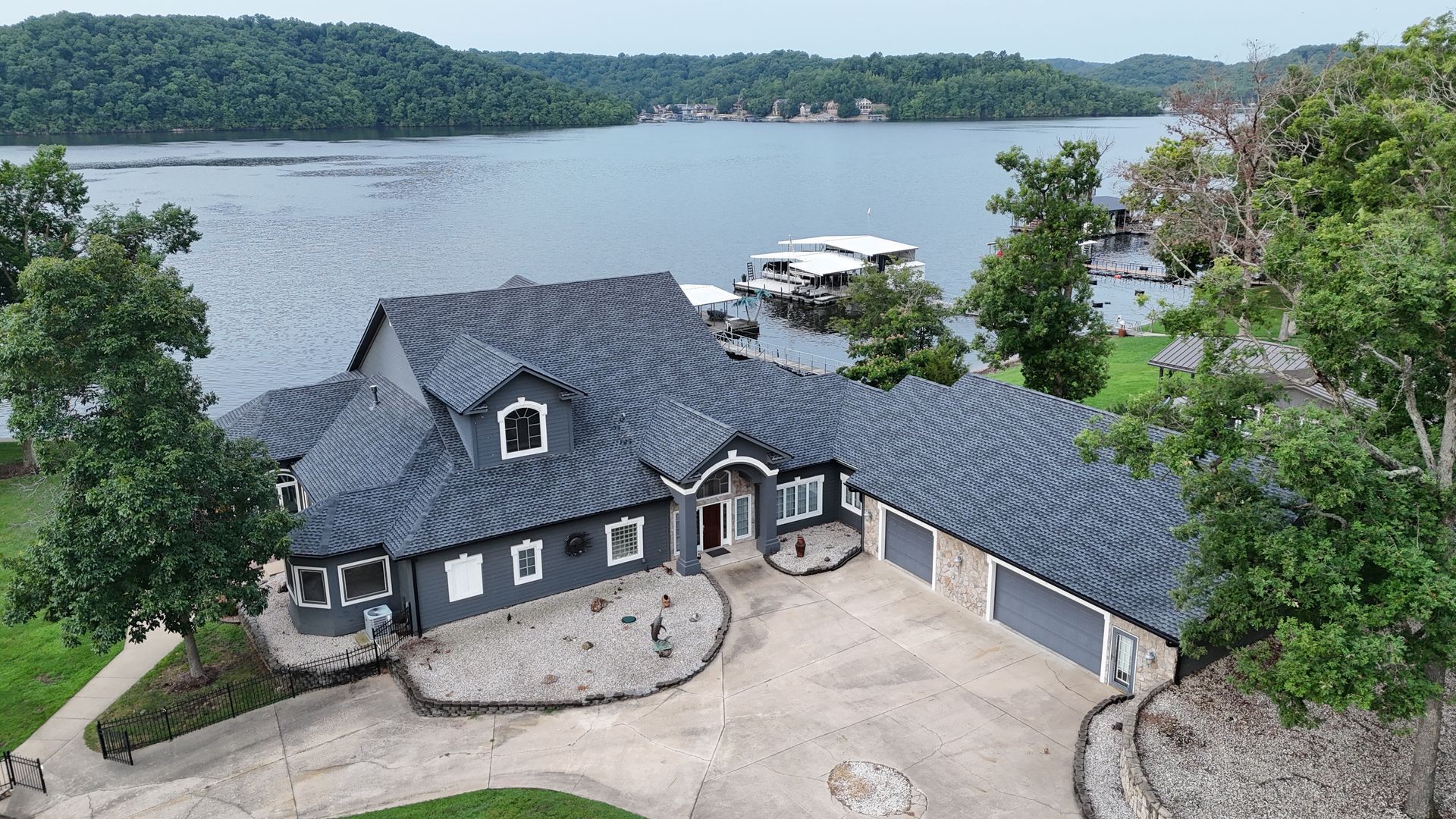
Choosing the best roofing material for Lake of the Ozarks homes is not the same decision a homeowner makes in a landlocked subdivision. Lake properties sit in a different environment: open water on one side, steep grades, heavy tree cover on the other, and long stretches of unshaded southern exposure. Those conditions wear a roof differently, and they change how the standard material comparisons play out.
Here is a practical look at what the Lake environment does to a roof, and how the three most common systems hold up against it.
What Makes a Lake Property Different
Wind exposure off open water. A home fronting the main channel or a wide cove has no windbreak. Wind coming across open water arrives without the friction that trees and neighboring structures create inland. That puts more stress on shingle edges, ridge caps, and any fastening at the perimeter, which is where wind damage typically starts.
Sun on unshaded elevations. Lakefront homes are usually oriented toward the water, not toward the shade. A roof plane facing south or west across the water absorbs a full day of direct sun with nothing blocking it. UV exposure and heat cycling are the slow, invisible half of roof aging.
Steep and complex rooflines. A lot of Lake homes are built into a hillside, with multiple levels, dormers, and roof planes that meet at odd angles. Every valley, transition, and penetration is a place where water has to be directed correctly. Complexity matters more than square footage on these homes.
Tree cover on the back side. The same lot that has open water in front often has mature oak and hickory behind it. That means shade, moisture retention, organic debris in valleys and gutters, and limbs to consider during storms.
Freeze and thaw. Missouri winters cycle above and below freezing repeatedly rather than staying frozen. Water works into small gaps, expands, and reopens them. Flashing details and underlayment quality carry a lot of weight here.
Seasonal occupancy. A significant share of Lake homes are second homes or short-term rentals. Nobody is walking the property in February. Problems that a full-time owner would catch in a week can run for months before anyone notices, which raises the value of materials and details that fail gradually rather than suddenly.
Architectural Asphalt Shingles
Asphalt remains the most common choice at the Lake, and for most homes it is a reasonable one. Modern architectural shingles are a meaningful step up from the three-tab products that dominated older Lake construction.
Where they fit well: homes with complex rooflines and many valleys, where the material has to be cut and fitted repeatedly. Asphalt is the most forgiving system to install around dormers, hips, and transitions. It is also the most cost-effective option per square, which matters on a large roof.
What to pay attention to at the Lake: wind rating and the quality of the installation at the edges. Manufacturer wind ratings are earned under specific installation conditions, including nailing pattern, starter strip, and ridge cap product. On an exposed lakefront elevation, those details are not optional extras. Ask what starter and ridge products are being used, not just the shingle line.
We install GAF systems, which allows the shingle, underlayment, starter, and ridge to be specified as a matched assembly rather than assembled from mixed components.
The tradeoff: asphalt has the shortest service life of the three systems discussed here, and heavy sun exposure works against it. On a fully unshaded lake-facing plane, granule loss shows up sooner than it does on a shaded inland roof.
Metal Roofing
Metal has become more common on Lake properties over the last decade, and the reasons line up with the conditions described above.
Where it fits well: simpler roof geometry, high sun exposure, and owners planning to hold the property long term. Standing seam systems have concealed fasteners and continuous panels, which removes many of the small failure points that accumulate on a shingle roof. Metal also sheds debris more readily, which is useful under tree cover.
What to pay attention to: metal is a fabrication trade as much as a roofing trade. Panel runs, seam type, and flashing details at valleys and penetrations determine whether the roof performs. On a complex Lake roofline with many planes, a metal installation requires more custom work and the cost gap over asphalt widens.
The tradeoff: higher upfront cost. The case for metal is made over a longer ownership horizon, not at the point of purchase. For an owner planning to sell within a few years, that math is harder to justify. For a primary residence or a long-held family property, it changes.
Flat and Low-Slope Systems
Many Lake homes have at least one low-slope section: a deck over living space, a walkout addition, a covered porch tied into the main structure. These areas need a membrane system rather than shingles or panels.
Single-ply membranes such as TPO and EPDM are the standard here. TPO is a lighter-colored membrane that reflects heat, which is relevant on a sun-exposed deck section. EPDM is a rubber membrane with a long track record in the field.
The critical point on low-slope areas is the transition. Where a flat section meets a pitched roof, or ties into a wall, is where nearly all low-slope leaks begin. That is a detailing question, not a material question, and it deserves specific attention during any estimate.
How to Narrow the Decision
A few questions get most Lake homeowners to an answer:
How long do you plan to own the property? Under five to seven years, asphalt usually makes more financial sense. Longer than that, metal deserves serious consideration.
How exposed is the roof? A home tucked into a shaded cove has different priorities than one facing open water on the main channel.
How complex is the roofline? More planes, valleys, and dormers push the cost of metal up faster than the cost of asphalt.
Is it a rental or a second home? Reduced oversight raises the value of a system with fewer discrete failure points.
What does the neighborhood or association allow? Some Lake developments have restrictions on roofing material and color. Worth confirming before you get attached to an option.
Talk It Through With Someone Who Works Here
Select Exteriors & Roofing works throughout the Lake of the Ozarks area, including Lake Ozark, Osage Beach, Camdenton, Sunrise Beach, Lebanon, Eldon, Rocky Mount, Jefferson City, and Columbia. We can walk your roof, look at the exposure and the existing details, and give you a straight comparison of what each option would cost and what it would mean for your specific home.
Related Posts