
Ha Ha Tonka Castle: Stone Ruins Above the Lake | Select Exteriors & Roofing
Ha Ha Tonka Castle: The Stone Ruins Above Lake of the Ozarks
A Kansas City businessman spent a fortune building a castle on a bluff near Camdenton. What survives is stone, and the reason it is only stone comes down to a roof.
Drive about five miles southwest of Camdenton, out toward the Niangua arm, and you come to a bluff with the remains of a stone mansion on top of it. Most people around the Lake of the Ozarks call it a castle. That is not quite what it was, but the name has stuck for more than a century and it is not going anywhere now.
Ha Ha Tonka is one of the most recognizable landmarks in Camden County, and the story of how it was built, and how it was lost, is more specific and more instructive than the postcard version suggests.
A Kansas City Businessman and a Bluff
Robert McClure Snyder was a wealthy businessman from Kansas City who came through the Ozarks in the early 1900s and decided he wanted the land. He began buying it in 1903 and 1904, a large tract on and around a bluff overlooking a spring-fed lake. Sources disagree on exactly how much he acquired, with figures ranging from around 2,700 acres to considerably more.
What he wanted to build there was a European style stone mansion, and construction began in 1905. Sandstone was quarried nearby and hauled to the site by mule-drawn wagon and a miniature railroad built for the purpose. Skilled stonemasons were brought in for the work. This was not a house that went up over a season.
Snyder never saw it finished. In October 1906 he was killed in what is generally described as one of the first automobile fatalities in Missouri. Construction stopped.
His sons took it up again and completed the building in 1922, though the Missouri State Parks account notes it was finished less elaborately than originally planned. Sixteen years had passed since the first stone went down.
The Lake Arrives
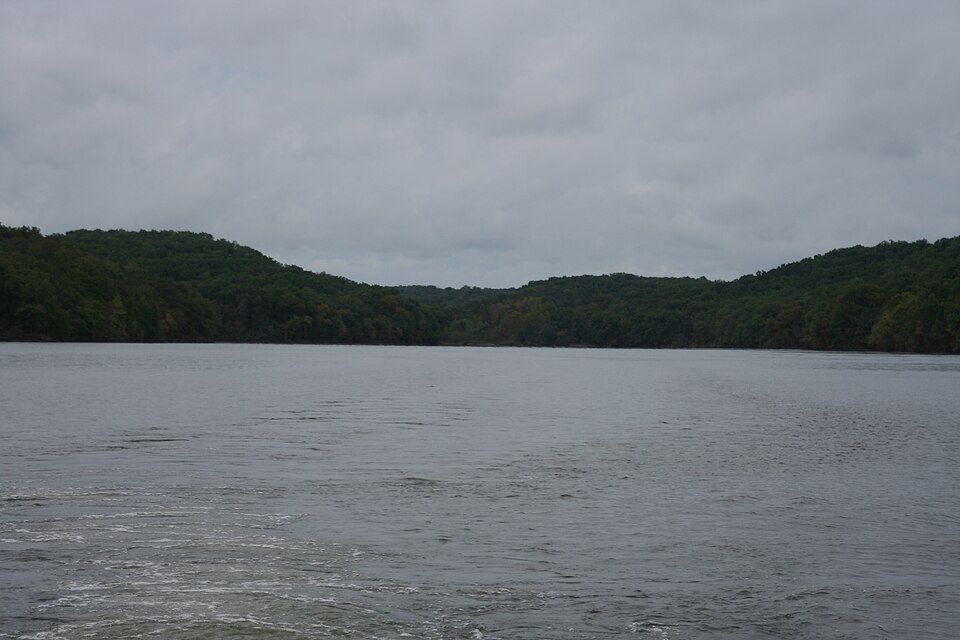
The castle was built to overlook a small spring-fed lake at the base of the bluff. That view was the entire point of the site.
In the 1920s, when construction of Bagnell Dam was proposed, the Snyder family fought it. They lost. The dam went in, the Lake of the Ozarks filled, and the rising water divided the estate and swallowed the small lake the house had been positioned to look at.
It is a strange piece of local history. The same impoundment that created the Lake of the Ozarks, and with it the economy that most of us here now depend on, also permanently altered the setting of the area's most photographed building.
The Fire
By the late 1930s the family fortune had been drained by legal battles and the Depression. The building was leased and operated as a hotel.
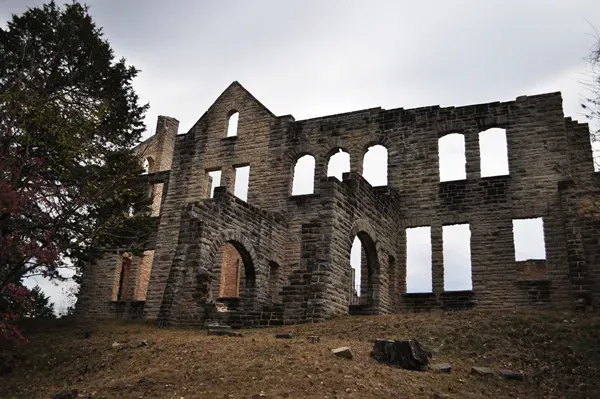
On a day in October 1942, sparks from one of the chimneys landed on the roof and caught. The fire gutted the castle within hours. The carriage house burned the same day. When it was over, the stone walls were still standing and essentially everything else was gone.
That detail is worth sitting with. The masonry did its job. Hundreds of laborers, years of quarrying, and a small railroad went into walls that are still up there in 2026. What failed was the roof, and everything the roof was protecting.
The stone water tower, eighty feet tall and built on the highest point of the bluff, survived that fire. It burned in 1976 after vandalism. The tower was later repaired, and part of that repair was a new roof.
From Ruin to State Park
Efforts to protect the area as public land go back to the early 1900s, when Missouri Governor Herbert S. Hadley visited and was struck by it. Several attempts failed. Ha Ha Tonka State Park was finally established in 1978.
The park now covers roughly 3,700 acres and includes about fifteen miles of trails running through caves, sinkholes, natural bridges, and the spring the place is named for. The name comes from the Osage language and is usually translated as laughing waters, though you will find laughing spirit and other variations depending on the source.
The castle ruins are still the centerpiece. The walls were stabilized in the 1980s, and a survey in 2016 found mortar and stone failure in portions of the structure with a real potential for collapse. Some areas have been closed to the public since. The ruins can be viewed from an observation point across from the park office.
Why a Century-Old Ruin Still Has Something to Say
There is a lesson sitting on that bluff that anyone who owns a building around here can use.
The stone at Ha Ha Tonka has outlasted everything else by more than eighty years. It was quarried well, cut well, and set by people who knew what they were doing. It is still standing. But stone alone did not save the building, because a structure is a system, and the roof is the part of that system standing between everything else and the weather.
The second half of the lesson is in the 2016 survey. Even the masonry, after decades without maintenance, began to show mortar and stone failure. Nothing on the outside of a building is permanent without upkeep. It just fails on a slower clock than the parts people notice first.
That is the same thing we look at on ordinary houses around the Lake, without the castle. As a roofing contractor in Lake Ozark, MO, Select Exteriors & Roofing evaluates visible exterior conditions and explains practical repair or replacement options to homeowners across Camden County and the surrounding area.
Visiting
Ha Ha Tonka State Park is open year round and free to enter, like all Missouri state parks. The Castle Trail is paved and accessible. The trails to the natural bridge, the spring, and the sinkholes are not, and some involve a substantial number of stairs.
If you live at the Lake and have somehow never gone, it is worth the drive. There are not many places in Missouri where you can stand on a bluff, look at the ruins of something that took seventeen years to build, and see the lake that changed what it was looking at.
Related Posts